Hi, I’m a personal finance expert who loves to help you out! I’ll answer your question within a business day. Pinky swear.

From 1 October 2026, businesses can no longer add a surcharge when you pay with a Visa, Mastercard, eftpos or American Express card. That’s a win at the checkout, but the same reforms also cut the fees banks earn from your card, and that’s why so many rewards cards are getting less generous right now.
So, is it good news or bad news? A bit of both, really. Here’s what’s changing, what isn’t, and how to make sure you come out ahead.
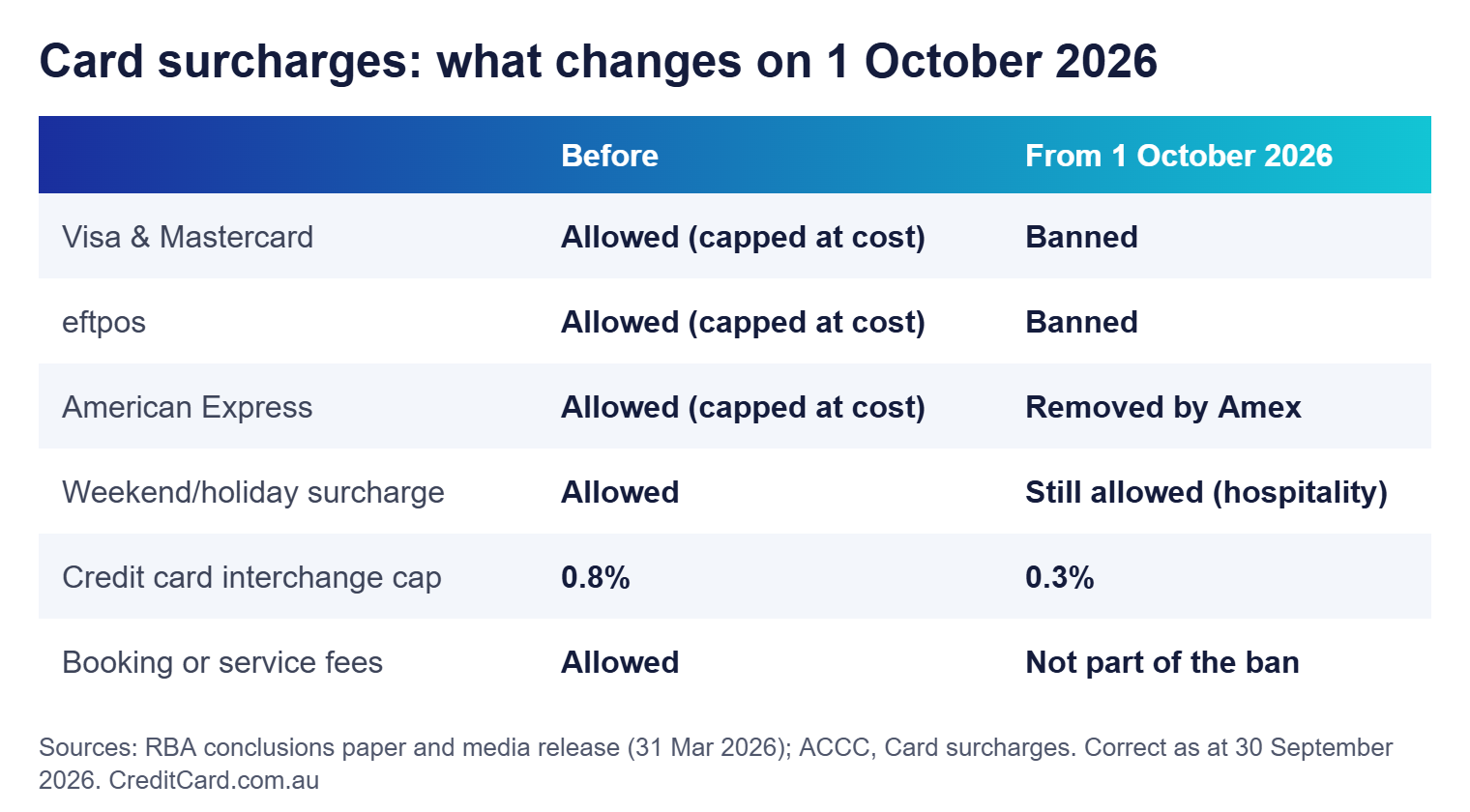
The ban is on card surcharges only. Hospitality businesses can still charge weekend and public holiday surcharges, and booking or service fees aren’t part of the ban. The price you see may also creep up, because the cost of taking cards can now be built into the sticker price.
Key numbers
- 1 October 2026: card surcharges end on eftpos, Mastercard, Visa and American Express
- ~$1.6 billion: what the RBA estimates consumers pay in card surcharges each year
- 0.8% → 0.3%: the cap on interchange fees for consumer credit cards
- $240 → $90: the most a bank can earn in interchange on $30,000 of your card spend a year (~, see below)
Methodology: surcharge and interchange figures from the RBA’s March 2026 conclusions paper and the ACCC, checked 30 September 2026. The $30,000 example multiplies annual spend by the old and new caps; it’s illustrative only.
What exactly is being banned?
From 1 October 2026, a business can’t charge you extra just because you pay by card on these networks:
- eftpos (debit and prepaid)
- Visa and Mastercard (credit, debit and prepaid)
- American Express (credit). Amex isn’t formally regulated by the RBA in the same way, but it has decided to remove surcharging too.
Until now, surcharges were allowed as long as they didn’t exceed what the business actually paid to accept the card. We’ve covered those older rules in our guide to excessive credit card surcharges. The new rules go a step further and remove card surcharges altogether.
What isn’t covered by the ban?
| Charge | From 1 October 2026 |
|---|---|
| Surcharge for paying by Visa, Mastercard, eftpos or Amex | Not allowed |
| Weekend and public holiday surcharges (hospitality) | Still allowed |
| Booking fees and service fees | Not part of the card surcharge ban |
| Other payment methods not listed above | Check before you pay, as the rules name these four networks only |
In other words, your Sunday brunch can still cost a bit more than your Tuesday one. What you shouldn’t see is a line on the receipt that says “card fee”.
Will prices go up instead?
Possibly, at some places. The RBA says that once surcharging ends, the sticker price will be the price you pay. Shoppers at businesses that currently surcharge are expected to pay similar amounts, just built into the price rather than added at the end.
The upside is that it’s much easier to compare prices, and there are no nasty surprises at the register. If you already shop mostly at places that don’t surcharge, you’re unlikely to notice much at all.
Why are banks cutting rewards?
This is the part that stings for points collectors. Every time you tap a credit card, the shop’s bank pays your bank an “interchange” fee. From 1 October 2026, the cap on that fee for consumer credit cards drops from 0.8 per cent to 0.3 per cent, and the old 0.5 per cent average benchmark is scrapped.
Here’s the simple maths on $30,000 of card spend a year:
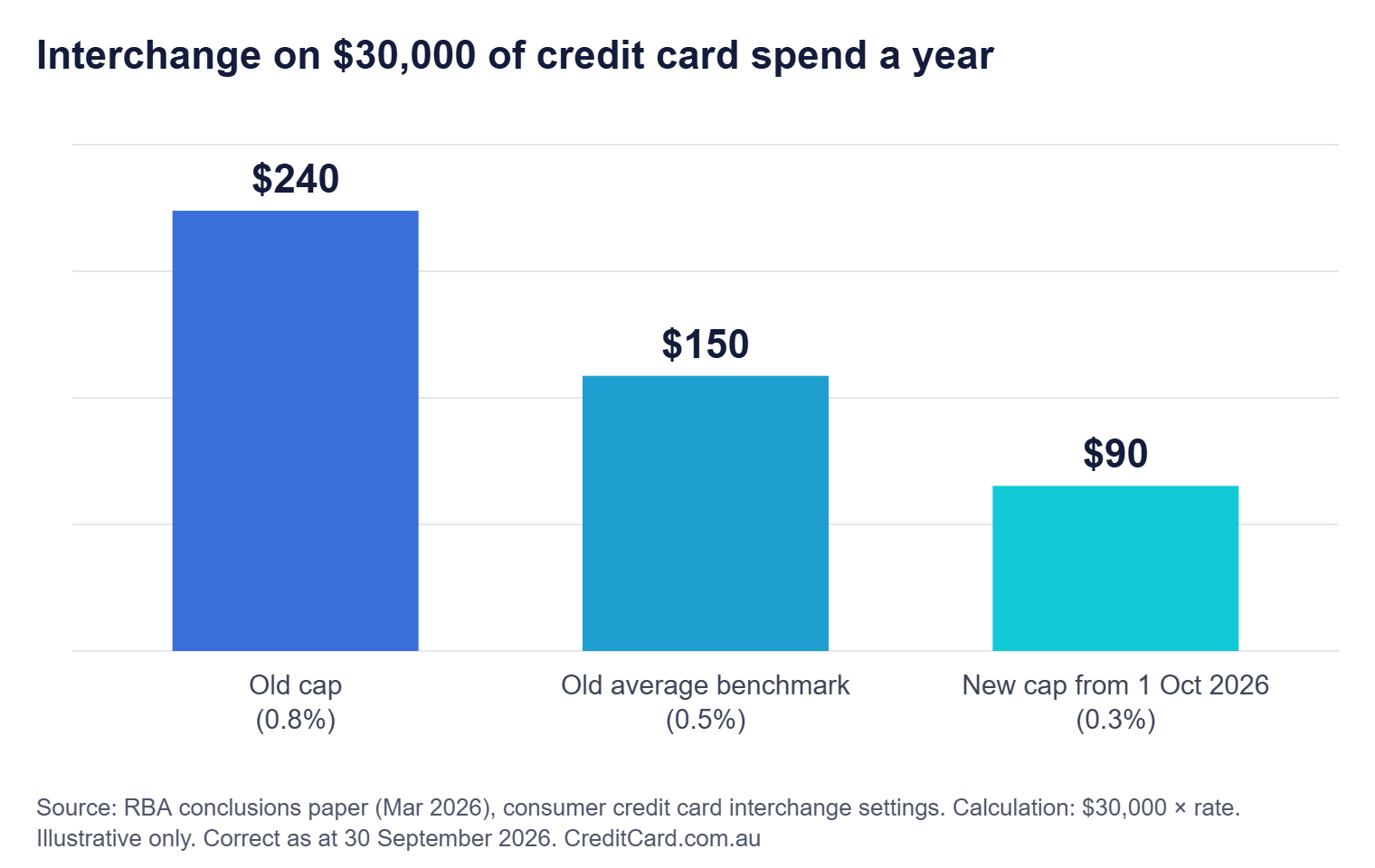
That’s a big hole in the money that has traditionally helped pay for points. The RBA has been clear that it doesn’t think interchange should fund rewards programs, and it expected banks to adjust their cards in response. Sure enough, several big banks have announced lower earn rates, points caps, higher fees or trimmed insurance. Before you assume your card is the same as last year, check your bank’s latest notices.
Does this change which credit card is right for you?
It might. A quick rule of thumb: every 0.25 points per $1 you lose on $30,000 of spend is 7,500 points. At our frequent flyer points valuation of 2.47 cents per Qantas Point (flight redemptions only), that’s ~$185 a year (7,500 × 2.47c).
Now compare that to what you save from the surcharge ban. Say you’d been paying a 1.5 per cent surcharge on $4,000 of your yearly spend. That’s $60 a year you won’t pay any more. It’s handy, but for a big spender it may not cover what a weaker rewards card costs you.
Tip: Work out your “points profit”: the value of the points you actually redeem each year, minus your annual fee. If it’s close to zero (or negative), a no annual fee card could now be the smarter pick.
“Getting rid of surcharges is a genuine win for everyday shoppers. But it’s the same set of changes that’s squeezing rewards cards, so don’t assume the card that suited you last year still does. Run the numbers, and if your points no longer beat your annual fee, it’s time to shop around.”
Pauline Hatch, credit card expert at CreditCard.com.au
What should you do if you’re still charged a surcharge?
The card networks enforce the ban through their own rules for businesses. According to the ACCC, if you’re surcharged for paying by card from 1 October 2026, you can:
- Raise it with the business first. It may simply not have updated its payment terminal yet.
- Contact the card network or the business’s payment provider.
- Report misleading pricing to your state or territory consumer protection agency.
- Report false or misleading price displays to the ACCC, which uses reports to guide its work (it doesn’t resolve individual complaints).
Frequently asked questions
Does the surcharge ban include American Express?
Yes. Amex isn’t formally regulated by the RBA in the same way as Visa, Mastercard and eftpos, but it has decided to remove surcharging from 1 October 2026 too.
Can cafés and restaurants still charge a weekend surcharge?
Yes. Hospitality businesses can keep charging weekend and public holiday surcharges. What they can’t do is add a separate fee because you paid by card.
Does the ban apply to debit cards as well?
Yes. It covers debit, prepaid and credit cards on the eftpos, Mastercard and Visa networks, so tapping your debit card shouldn’t cost extra either.
Are rewards credit cards still worth it?
For some people, yes. If the points you actually redeem are worth more than your annual fee, a rewards card can still pay its way. If not, you may be better off with a lower-fee card. Compare the latest offers on our rewards card page.
Final tips
- Enjoy the simpler checkout, but keep an eye on sticker prices at places that used to surcharge.
- Read any letters or emails from your bank. Earn rates, caps, fees and insurance are all changing on some cards.
- Do the points maths once a year. If the value doesn’t beat the fee, compare frequent flyer cards or a no annual fee card instead.
- Pay in full each month. Interest wipes out the value of points faster than any rule change. Moneysmart’s guide to choosing a credit card is a good place to start.
Want the official detail? The RBA has a plain-English summary of the surcharging review.
General advice only: this article is general information and doesn’t take into account your objectives, financial situation or needs. Consider the Target Market Determination (TMD), the terms and conditions and the product disclosure documents before applying for any credit card. Surcharge and interchange details are based on RBA and ACCC information. Card details are correct as at 30 September 2026 and can change.
Pauline Hatch
Pauline is a personal finance expert at CreditCard.com.au, with 9 years in money, budgeting and property reporting under her belt. Pauline is passionate about seeing Aussies win by making their money – and their credit cards – work smarter, harder and bigger.
You might be interested in


Recently Asked Questions
Something you need to know about this card? Ask our credit card expert a question.
Ask a questionHi, I’m a personal finance expert who loves to help you out! I’ll answer your question within a business day. Pinky swear.