
Hi, I’m a personal finance expert who loves to help you out! I’ll answer your question within a business day. Pinky swear.

A credit card can be handy for Black Friday shopping if you can repay what you spend and the card’s benefits actually apply. Before you buy, check the seller, the full price, your repayment plan, the rewards rules and any purchase protection.
A sale price is only the starting point. Interest and fees can eat into the saving, and paying by card does not make a fake shop safe. A countdown timer is a reason to pause, not permission to skip your checks.
Key numbers
- $25 billion: Australian online spending in the September quarter of 2026.
- 17 per cent: the year-on-year rise in that spending.
- $90: the average online basket, down 6.8 per cent year on year.
Methodology: CommBank iQ figures reported in CommBank’s November 2026 Black Friday analysis, checked on 6 November 2026. These describe online spending across payment methods, not credit-card spending alone.
Why check your card before the Black Friday sales?
Fresh CommBank analysis suggests Australians are shopping online more while keeping individual baskets smaller. That makes the price of each purchase worth a closer look, especially when several small orders land on the same statement.
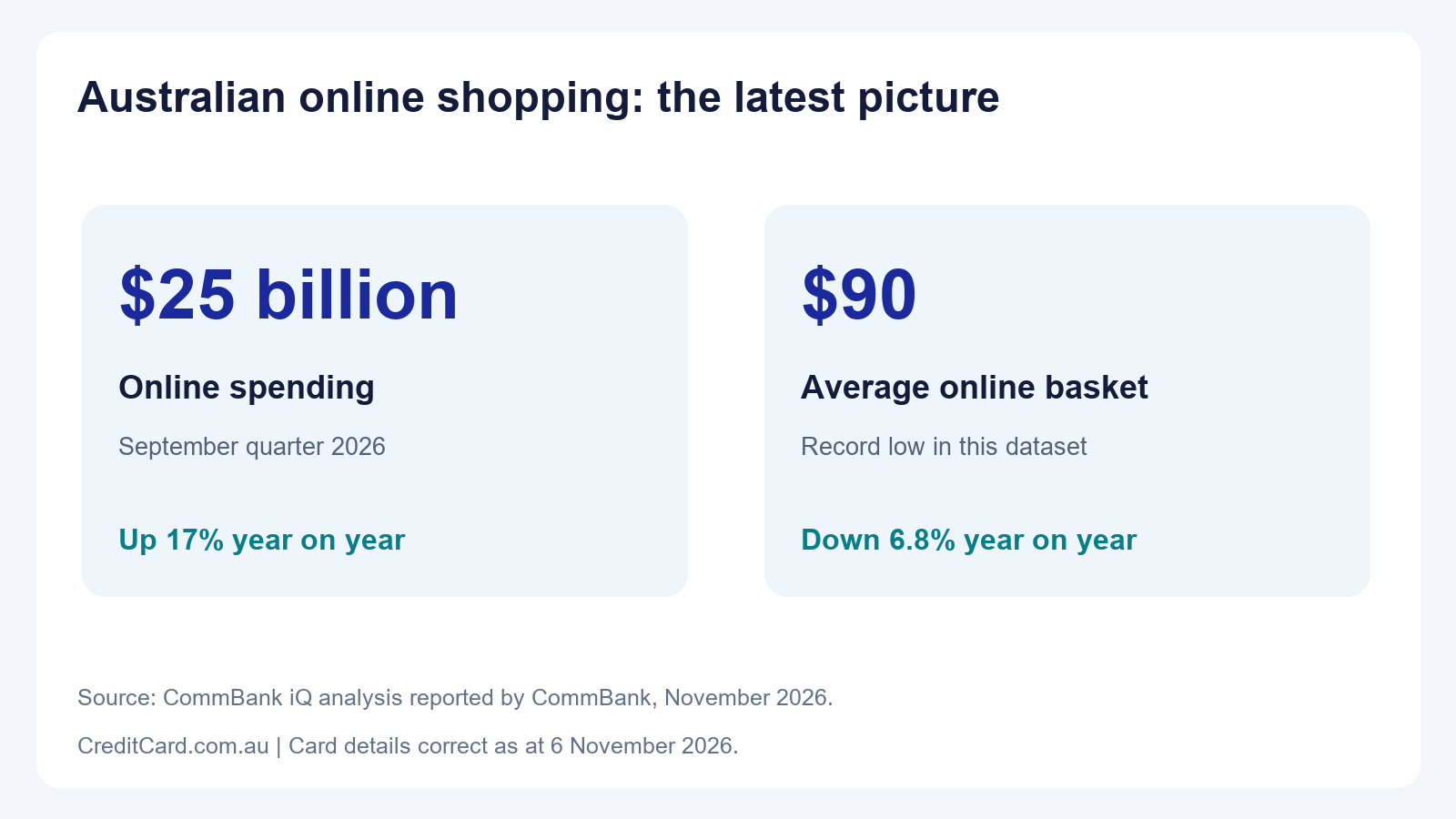
| Australian online shopping | Figure | Change year on year |
|---|---|---|
| Online spending (September quarter 2026) | $25 billion | Up 17% |
| Average online basket (record low in this dataset) | $90 | Down 6.8% |
Source: CommBank iQ analysis reported by CommBank, November 2026.
Online spending reached $25 billion in the September quarter of 2026, up 17 per cent from a year earlier. The average basket fell 6.8 per cent to $90, the lowest level in this dataset. More online spending does not tell us whether shoppers can comfortably repay it.
The useful question is simple: would you still buy this item, at this price, if there were no points or sale banner attached? If the answer is no, leave it in the cart for a while. The internet will cope.
Is the seller real, and is the price actually good?
Start with the retailer’s own website rather than a link in an unexpected message. Check the contact details and returns information. Search for independent reviews, and be wary of a shop that looks familiar but has a slightly different web address.
Scamwatch warns that scammers can copy real businesses and create fake reviews. Unusually low prices and pressure to pay in unusual ways are warning signs. A professional-looking checkout is not proof that the business is genuine.
Compare the delivered price with another retailer and, where you can, the item’s recent price. Keep the model number handy: a cheaper-looking appliance may be a different version. Check the seller’s own return terms before paying, especially if you are buying a gift.
What will the purchase cost you to repay?
Write down the purchase price and the date you can clear it. Then look at what is already owing on the card. A repayment plan for one bargain is not much use if it forgets the rest of your statement.
For a simple illustration, an item reduced from $600 to $480 has a $120 discount. If using credit adds $30 in interest and fees, the total becomes $510 and the saving falls to $90. These are assumed amounts to show the calculation, not an offer or a prediction of your card costs.
| Illustrative check | Amount |
|---|---|
| Original price minus sale price | $600 − $480 = $120 discount |
| Sale price plus assumed credit costs | $480 + $30 = $510 total |
| Original price minus total cost | $600 − $510 = $90 saving |
Check how interest-free days work on your account. They are different from a promotional purchase offer. If you are considering a plan, read its fees and what happens when the promotion ends. A minimum repayment is not the same as a plan to clear the purchase.
Are the rewards and purchase benefits still worth using?
Check your card’s current terms before relying on a familiar perk. Earn rates, spending caps and exclusions can affect the points you receive. Any separate rewards-program fee belongs in the cost comparison too. Our rewards comparison can help you compare features without treating points as free money.
Purchase protection is also separate from a retailer refund or a disputed card transaction. Check whether your card has cover, how to qualify and which items or events are excluded. Keep the receipt and order confirmation. Do not assume every rewards card protects every purchase.
Pauline’s tip: Give each planned purchase a line in your budget before the sales start. Add the delivered price and your repayment date. You will spot an awkward total much faster than by watching separate shopping carts.
What should you save before closing the checkout?
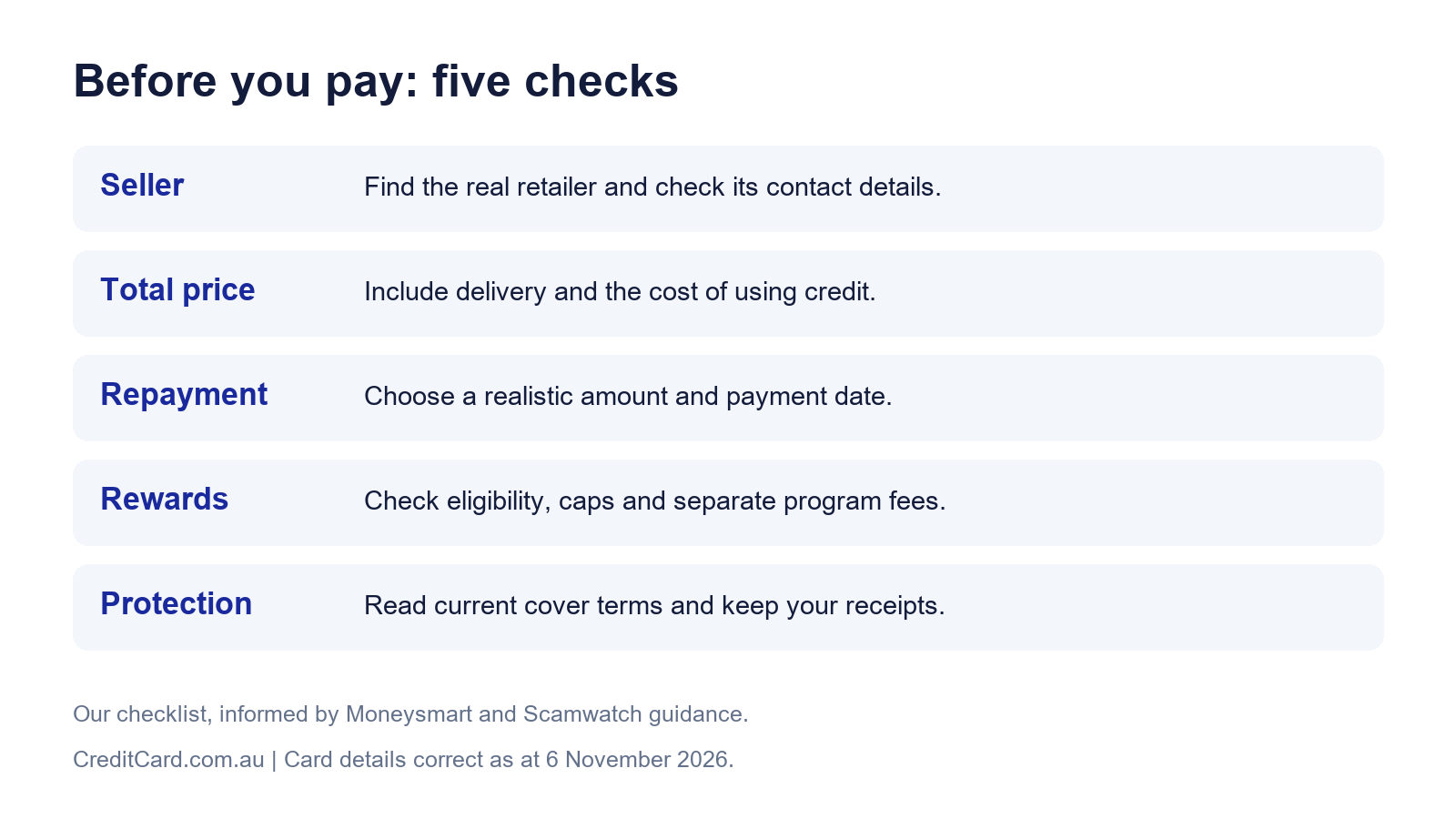
Check the seller’s identity and the full price, choose a realistic repayment date, confirm the rewards rules and read the current protection terms. Save your receipts alongside those details so you have a useful record if something goes wrong.
If an order does not arrive, keep your contact with the seller in writing and ask your bank promptly about the available dispute process. Our guide to why a chargeback may be denied explains why a refund through your card is not guaranteed. If you suspect a scam, contact your bank immediately.
“The best bargain is something you needed, bought from a real seller and paid for without an expensive surprise.”
Frequently asked questions
Should I use a credit card for Black Friday shopping?
It depends on your repayment plan and the card’s costs. Check that the seller is genuine and that any rewards or protection you want actually apply. Using credit does not make an unaffordable purchase a bargain.
Do credit card points make a sale purchase cheaper?
Only if the rewards you can use outweigh any extra costs. Check eligible spending, points caps and separate program fees. Avoid buying something just to collect points.
Does every credit card include purchase protection?
No. Check your card’s current insurance terms for eligibility and exclusions before relying on cover. Keep the receipt and order confirmation.
What if I think I paid a fake online shop?
Contact your bank immediately and keep your payment records and messages. Report the suspected scam to Scamwatch. Do not assume that a credit card payment guarantees recovery.
Final tips
Make a short shopping list and set a total you can afford before browsing. For help comparing features against costs, Moneysmart’s card guide is a useful starting point. Our older Black Friday travel-points article covers a different angle; check all current card and reward terms before using any historical example.
General information only, not personal advice. Consider your circumstances and read the relevant Target Market Determination (TMD), fees and T&Cs before applying for or using a credit card. Card details correct as at 6 November 2026 and can change. The price example uses assumed amounts and is not a current card offer. Sources: the linked CommBank iQ analysis, Moneysmart and Scamwatch guidance.
Pauline Hatch
Pauline is a personal finance expert at CreditCard.com.au, with 9 years in money, budgeting and property reporting under her belt. Pauline is passionate about seeing Aussies win by making their money – and their credit cards – work smarter, harder and bigger.
You might be interested in
Recently Asked Questions
Something you need to know about this card? Ask our credit card expert a question.
Ask a questionHi, I’m a personal finance expert who loves to help you out! I’ll answer your question within a business day. Pinky swear.